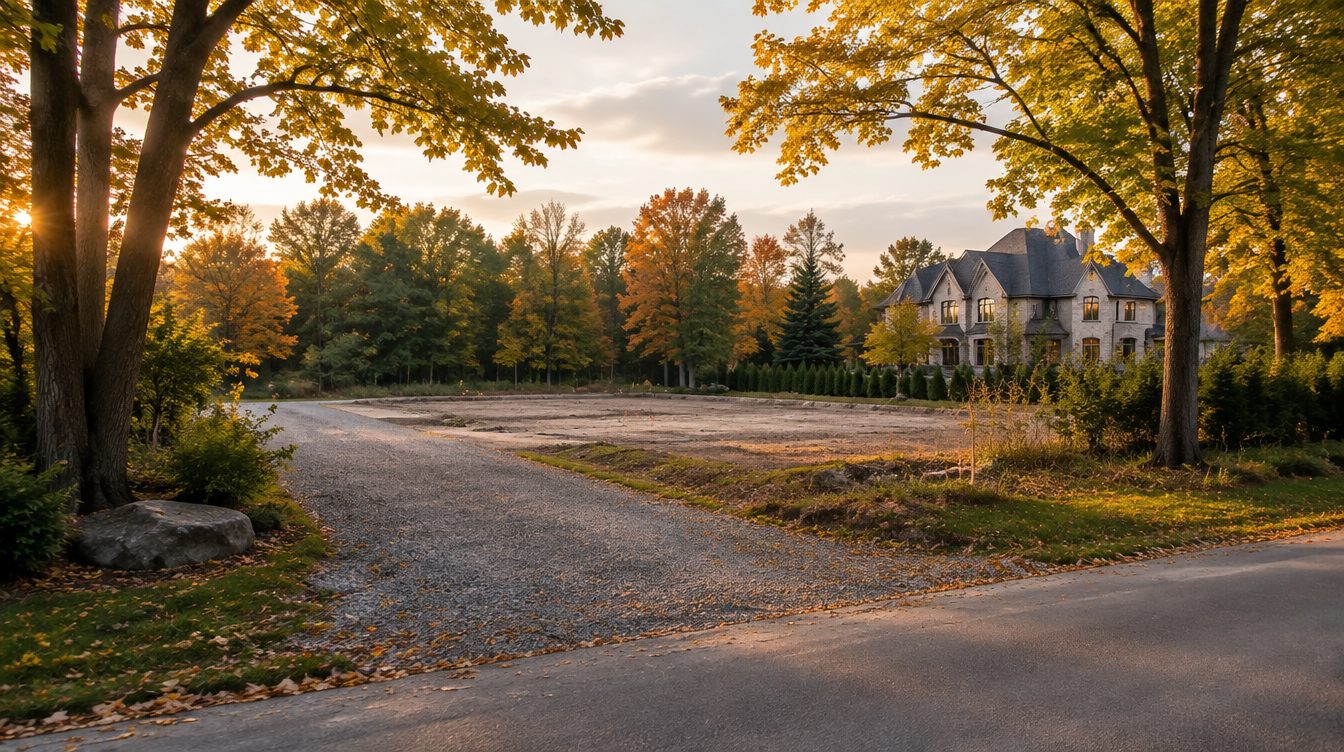
Aurora just had its quietest August on record for home sales, according to NewmarketToday, while nearby Newmarket stayed relatively active despite fewer listings. If you are watching Aurora because you want to build, not just buy, that headline probably raised a question: does a slow month mean opportunity, or does it mean something is wrong with the market.
The honest answer is neither, on its own. A record low August sales figure tells you about resale transaction volume for finished homes. It does not tell you much about the lot market, which moves on a different clock and answers to different buyers. But it is still worth understanding, because it shapes how sellers of land behave right now, and that behaviour is exactly what a custom-build family needs to read correctly before making an offer.
What a quiet resale month actually changes for land sellers
When finished-home sales slow, some owners of large parcels, estate lots, and teardown-ready properties start to feel it too. Fewer showings, fewer offers, more time to think. That does not mean lot prices collapse. Land in Aurora, especially anything near Bathurst, St. John's Sideroad, or the established pockets around Hunters Glen, tends to hold its price because there simply is not much of it and it does not get made again.
What changes is seller patience and seller flexibility. A vendor who watched their neighbour's finished home sit through a slow August is more open to a longer closing, a conditional offer tied to severance or zoning confirmation, or a price conversation that would have been a non-starter in a hotter spring. That is the real opening a quiet month creates: not a discount on land value, but room to negotiate terms that make a custom build easier to finance and sequence.
I saw a version of this dynamic play out in Aurora's broader estate market this year. As I wrote in Aurora's Quiet Giant, the top end of York Region moved a significant volume of dollars through the first half of 2026 even while headline activity looked subdued. Land and custom-build buyers were part of that quiet strength. They were not waiting for a crash. They were waiting for the right lot and the right terms.
Where budgets and timelines actually slip on a lot purchase
Families come to me focused on the purchase price of the land. That is rarely where a custom build goes sideways. The slippage happens in three places, almost every time.
First, due diligence timelines get compressed because buyers are excited and want to move fast on a lot that finally checked every box. Rushing severance confirmation, well and septic assessment where applicable, or zoning and setback review is how a family ends up owning a beautiful parcel they cannot build what they wanted on. I covered this in detail in Acreage Due Diligence, and the same discipline applies to infill and estate lots inside Aurora, not just larger rural parcels.
Second, the gap between closing on the land and breaking ground gets underestimated. Permitting, architect finalization, and builder scheduling all take longer than families expect, and carrying costs on an empty lot are real even before a shovel goes in.
Third, families price the build using a number they heard somewhere rather than a builder-specific quote tied to the actual lot conditions. Grading, tree removal, soil quality, and servicing all move the true cost, and they move it before finishes are even discussed. This is exactly why a slow resale month should not be read as a green light on its own. It is a signal to slow down and verify, not a signal to rush in because things look quiet.
A short checklist before you make an offer on Aurora land
- Confirm zoning and permitted use in writing, not from a listing description alone.
- Get a written severance or consent status if the lot was ever part of a larger parcel.
- Order a preliminary grading and drainage opinion before you fall in love with the site.
- Ask your builder to walk the actual lot, not a similar one, before giving you any cost range.
- Build a carrying-cost estimate for the full gap between closing and permit issuance.
- Negotiate closing timing around your design and permitting schedule, not the seller's calendar, especially in a quieter market where sellers have more room to agree.
Reading the wider market without overreacting to one number
RBC's recent commentary noted that Canada's economy has shown resilience even as rate risks remain part of the conversation, and separately that inflation has stayed contained enough to support a steady Bank of Canada stance. Neither of those points is about Aurora specifically, but together they explain why land and custom-build buyers have kept moving steadily through 2026 rather than waiting on the sidelines. Financing conditions have not been the obstacle. Confidence and the right lot have been the obstacle, and a quiet August in the resale numbers does nothing to change either of those for a well-prepared buyer.
If you are also weighing whether to build new or buy an existing home and renovate, the framework I laid out in Custom Build or Renovated Resale? applies just as well north of Oakville as it does within it. The math changes by street, not by the calendar month you happen to be reading headlines in.
What this means for you
A record low August in Aurora's resale market is a real data point, but it describes finished homes, not the land you are trying to buy or the build you are trying to plan. Use the quieter climate to negotiate terms, not to skip due diligence. The families who do best in Aurora right now are the ones treating a soft month as leverage on timeline and flexibility, while still verifying zoning, servicing, and true build costs with the same rigour they would apply in a busy spring.
If you are looking at a specific lot in Aurora, or trying to decide whether this is the season to move on land you have had your eye on, what is actually holding you back: the price, the timeline, or the uncertainty about what you can build there? Jai, with The Agency, Toronto, works with buyers, sellers, and custom-build clients across the GTA and is glad to have a ten-minute conversation about your own situation, offered as a courtesy, never a pitch.